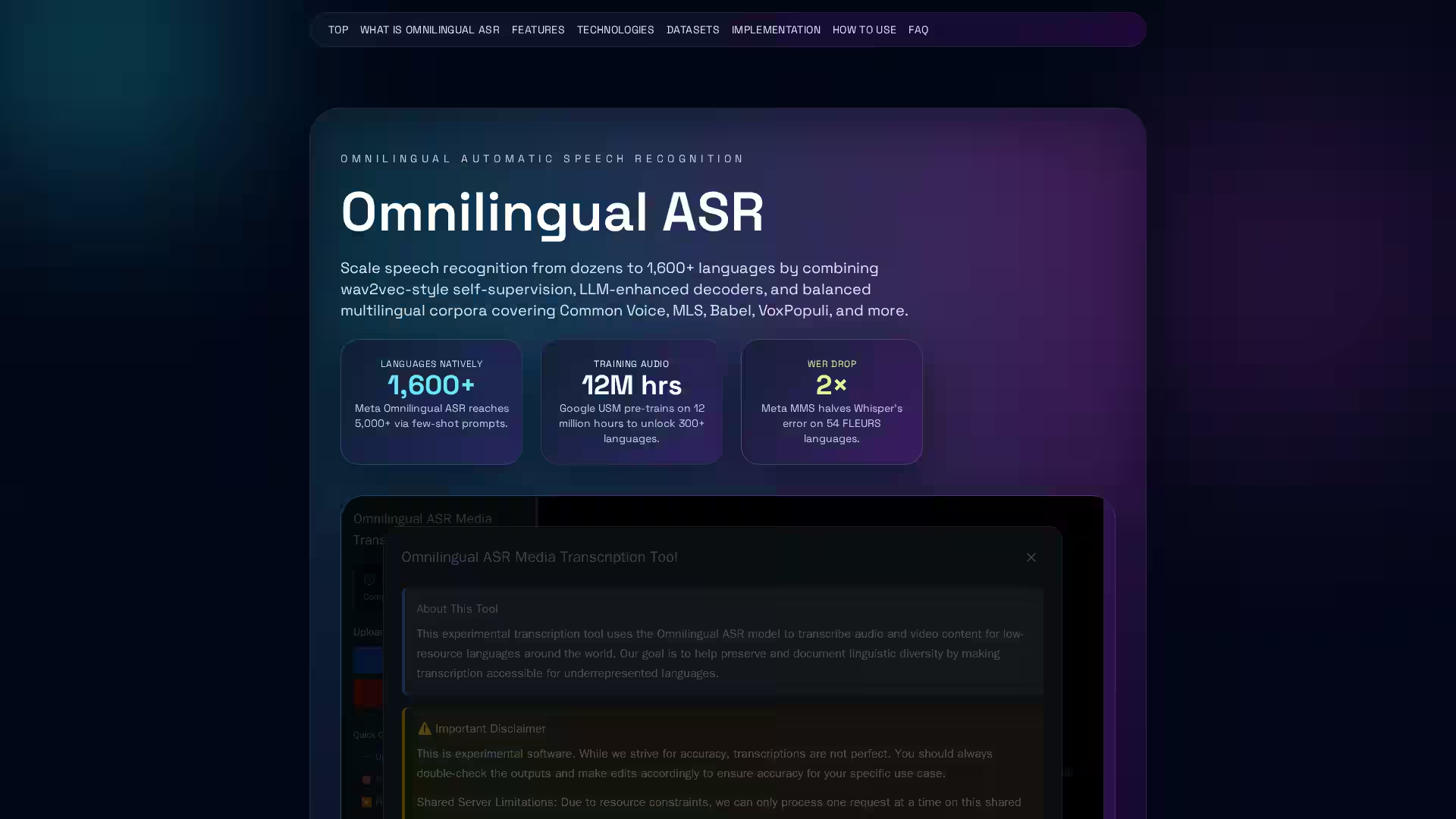
Omnilingual ASR is a state-of-the-art automatic speech recognition system designed to unify and scale speech-to-text capabilities across more than 1,600 native languages, with potential extension to over 5,000 languages using few-shot learning. By combining advanced wav2vec-style self-supervised encoders, Large Language Model (LLM) enhanced decoders, and carefully balanced multilingual corpora, Omnilingual ASR represents a groundbreaking leap forward in multilingual speech technology. Backed by foundational research from top AI labs including Meta, Google, and OpenAI, it uses diverse datasets such as Common Voice, MLS, Babel, and VoxPopuli to train on upwards of 12 million hours of audio, delivering highly accurate and low-error transcriptions even in low-resource or uncommon languages.
Omnilingual ASR merges innovations such as Meta’s Massively Multilingual Speech (MMS) models and Google’s Universal Speech Model (USM) with advanced transformer-based decoders to provide broad language coverage using a single unified model. Its open-source releases (Apache 2.0 licensed) and cloud deployable APIs (via Google, Microsoft, AWS) offer flexible options for both research and production use, enabling global-scale speech recognition applications.
Key Features
Language-Adaptive Encoders: Omnilingual ASR employs wav2vec 2.0, Conformer, and MMS encoders that share acoustic representations across languages, helping low-resource languages benefit from data-rich languages.
LLM-Enhanced Decoders: Transformer decoders fine-tuned as language models improve transcription grammar and enable simultaneous translation.
Few-Shot Extensibility: The system can expand coverage beyond 1,600 languages to over 5,000 via in-context few-shot prompts, allowing community-driven model growth from minimal data.
Integrated Language Identification: Models like Whisper emit language ID tokens upfront, while MMS provides classification for 4,000 languages, allowing accurate processing of code-switching and mixed language audio.
Balanced Training Strategy: Oversampling of underrepresented languages ensures that recognition error rates narrow between high- and low-resource languages, improving universality.
Deployment Flexibility: Available as open-source checkpoints or cloud-native APIs with support for diarization, streaming, translation, and customization via fine-tuning or external vocabularies.
Global Captioning & Subtitling: Generate accurate subtitles across hundreds of languages for media, conferences, and education.
Multilingual Virtual Assistants: Power voice-based assistants that interact fluently in over a thousand languages.
Call Center Analytics: Analyze multilingual call recordings to extract insights and improve customer experience.
Low-Resource Language Preservation: Equip minority language communities with modern speech technologies through few-shot learning.
Research & Development: Utilize open source checkpoints and datasets to fine-tune or benchmark ASR models for proprietary domains.
FAQ
Q: What languages does Omnilingual ASR support?
A: It natively supports over 1,600 languages and can extend up to 5,000+ with few-shot learning prompts.
Q: Is Omnilingual ASR open source?
A: Yes, core components including Meta’s Omnilingual ASR models and MMS are released under the Apache 2.0 license.
Q: Can Omnilingual ASR handle code-switching?
A: Yes, integrated language ID models allow it to detect and transcribe mixed-language audio effectively.
Q: What deployment options are available?
A: Users can deploy open-source models locally or access cloud APIs from Google, Microsoft, and AWS, depending on latency, scalability, and compliance needs.
Q: What datasets were used to train Omnilingual ASR?
A: Training involved diverse corpora including Common Voice, Multilingual LibriSpeech, Babel, VoxPopuli, and others totaling over 12 million hours of audio.
Q: How accurate is Omnilingual ASR?
A: On multilingual benchmarks like FLEURS, Omnilingual ASR achieves half the word error rate compared to models like OpenAI Whisper, especially for low-resource languages.
Q: How can I fine-tune or customize the model?
A: Fine-tuning can be done with frameworks like Hugging Face Transformers, ESPnet, or NVIDIA NeMo, using your domain-specific audio with minimal labeled data.
Q: Is the model suitable for real-time transcription?
A: Yes, streaming-friendly OmniASR variants and API services support low-latency transcription with diarization and translation capabilities.