Newsletter
Join the Community
Subscribe to our newsletter for the latest news and updates


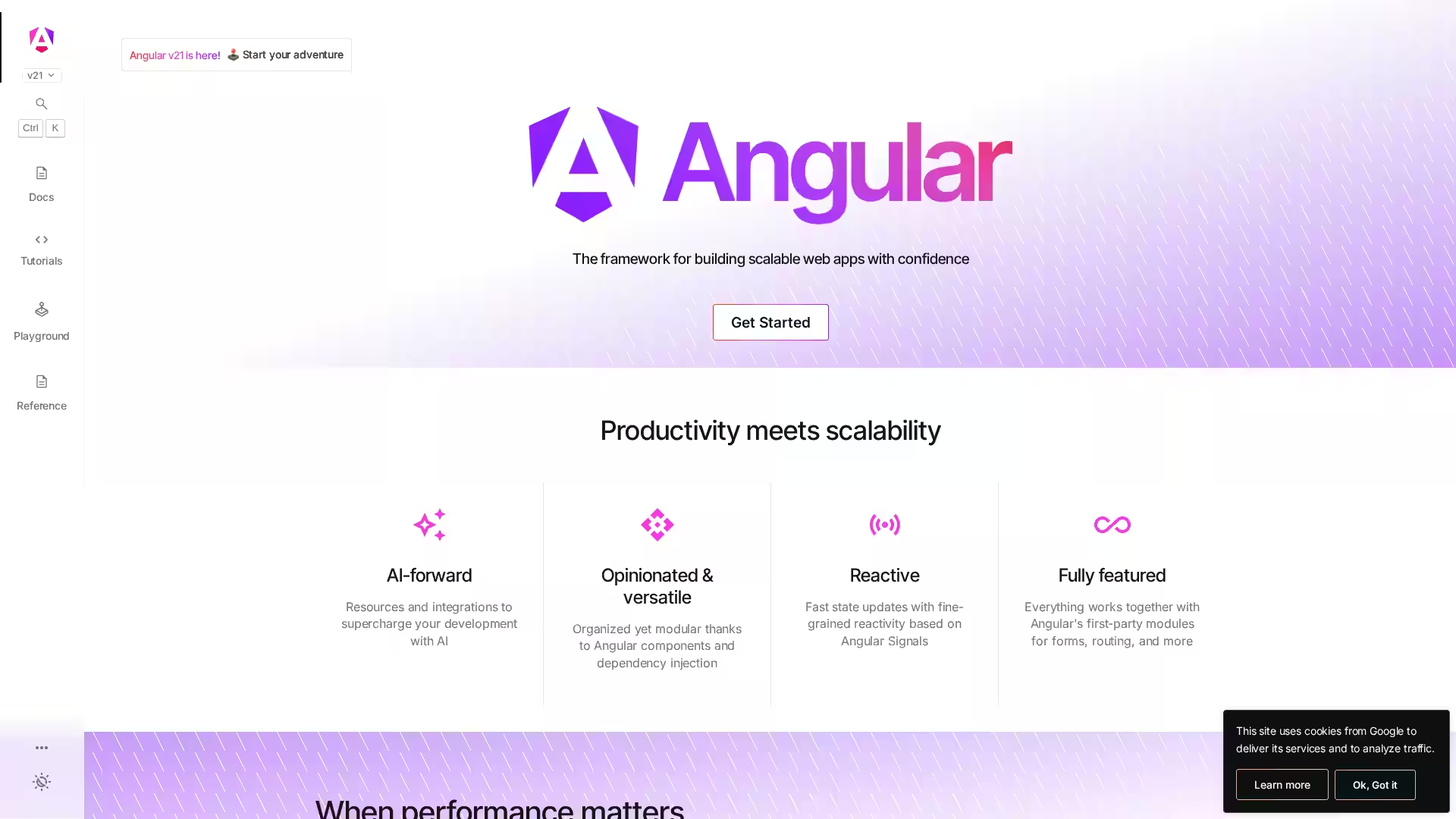
A powerful, scalable TypeScript-based web framework for building fast, reliable, and modular applications.
Angular is a comprehensive, opinionated, and highly scalable framework for building dynamic web applications using TypeScript. Developed and maintained by Google, Angular provides a unified development experience that integrates essential tools directly into the framework—such as routing, forms, state management, and server-side rendering—allowing developers to go from concept to deployment with confidence and efficiency.
Angular v21 introduces exciting updates, including AI-assisted development workflows, improved fine-grained reactivity with Angular Signals, and next-generation rendering strategies such as SSR (Server-Side Rendering), SSG (Static Site Generation), hydration, and deferred loading. These features empower developers to deliver fast, reliable, and responsive applications that scale seamlessly with the needs of their users and teams.
At its core, Angular is designed to balance productivity with scalability. Developers benefit from built-in conventions and a robust dependency injection system, while still being free to modularize projects according to custom requirements. This makes Angular a great fit for everything from small internal tools to enterprise-scale systems that serve millions of users.
Angular applications are built with components—self-contained units of logic, template, and style—that promote reusability and maintainability. Components are easy to organize, test, and evolve, making the project’s codebase cleaner over time.
A powerful DI mechanism allows Angular to efficiently manage service instances, maximize code reuse, and simplify testing. This supports modular design and reduces tight coupling between parts of the application.
With fine-grained reactivity through Signals, Angular can track and update UI states more efficiently, resulting in a smoother user experience and reduced performance overhead.
Routing, forms management, HTTP services, and more are provided out of the box, eliminating the need to manage a fragmented set of third-party dependencies.
Options like SSR, SSG, and hydration allow developers to optimize for performance and SEO. Deferred loading further enhances page speed for large, complex applications by loading parts of the UI only as needed.
Integration with AI tools and resources provides developers with best practices, code templates, and intelligent prompts to accelerate productivity.
Angular supports building applications across various environments, whether web-based, mobile, or desktop, maximizing code reuse.
Backed by Google and a vast developer community, Angular has extensive documentation, tutorials, and community support through GitHub, Stack Overflow, and dedicated forums.
Angular's modular architecture and built-in features make it optimal for complex applications with large teams, where maintainability and scalability are crucial.
Angular provides efficient routing, component reuse, and reactive state management—all key ingredients for building responsive SPAs.
Angular's fast rendering and state handling help deliver high-performance online shopping experiences.
Dynamic, data-driven dashboards can benefit from Angular’s reactive updates and streamlined API integration.
Developers can integrate AI capabilities directly into their applications using Angular's AI resources and best practices.
Angular’s robust form handling and state management make it ideal for building rich, interactive learning management systems.
Q: Who should use Angular? A: Angular is ideal for developers who value a structured, fully-featured framework with strong conventions, whether building small tools or enterprise applications.
Q: Does Angular work only in TypeScript? A: Angular is built with TypeScript and TypeScript is recommended, but it also supports JavaScript.
Q: How does Angular handle performance? A: Angular offers fine-grained reactivity with Signals, optimized change detection, and advanced rendering options to meet performance demands.
Q: Is Angular suitable for SEO-focused applications? A: Yes. Server-Side Rendering (SSR) and Static Site Generation (SSG) help improve SEO for Angular applications.
Q: Can Angular integrate with AI tools? A: Yes. The framework’s new AI-forward features offer strategies, prompts, and integration points for AI-powered solutions.
Q: How steep is the learning curve? A: For developers new to frameworks, Angular’s in-browser tutorials make onboarding quick. For experienced developers, essential guides offer condensed explanations.
Q: Is Angular free to use? A: Yes. Angular is open-source, code licensed under an MIT-style license, and documentation under CC BY 4.0.
Q: Where can I learn more? A: Angular.dev provides documentation, tutorials, guides, AI resources, and community links to help you learn and grow with Angular.
Angular is more than a framework—it’s a complete platform that enables developers to build scalable, maintainable, and high-performance applications. Whether you’re building your first dynamic web app or maintaining a complex enterprise solution, Angular gives you the tools, structure, and flexibility to succeed.